


You are viewing 1 of your 1 free articles
Investor interview: how Octopus Capital’s Jack Burnham plans to reach 1,000 homes – then double it
After raising its first tranche of overseas investment, Octopus Capital is confident of scaling up and building more homes with zero energy bills. Denise Chevin speaks to head of affordable housing Jack Burnham to find out more


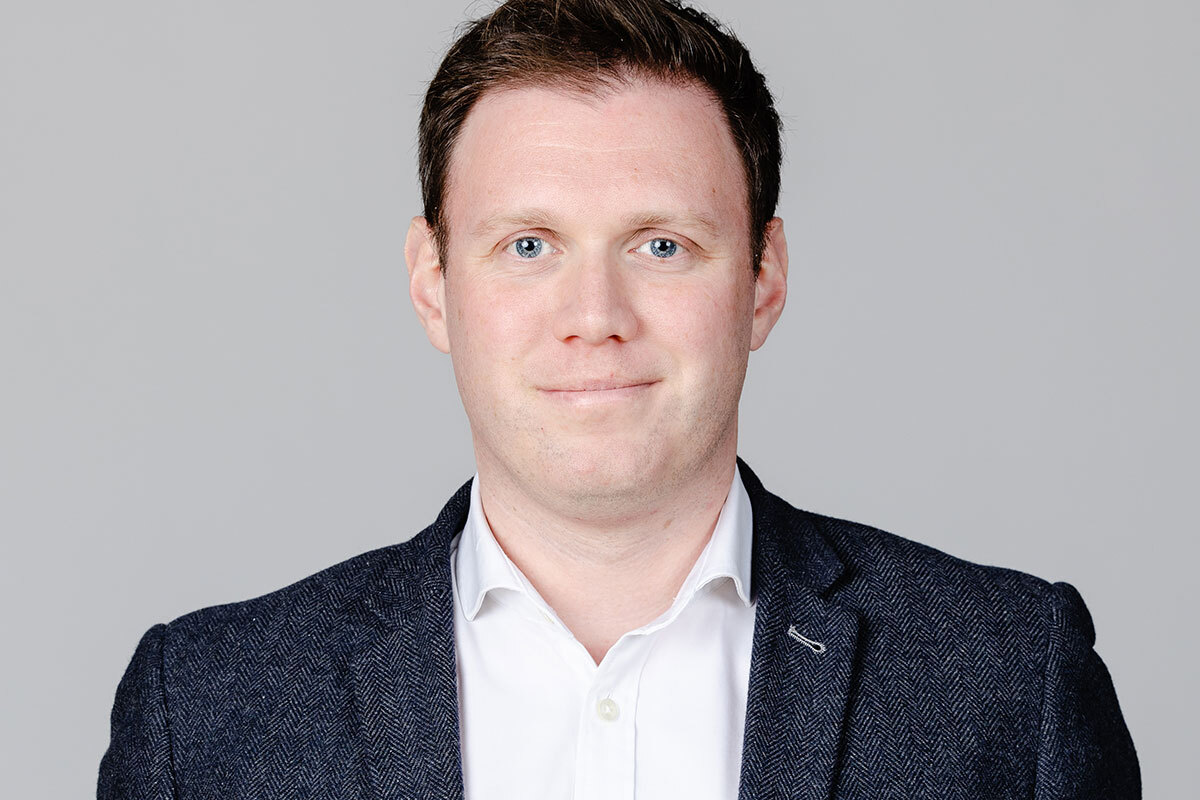 Investor interview: how Octopus Capital’s Jack Burnham plans to reach 1,000 homes – then swiftly double it #UKhousingAfter raising its first tranche of overseas investment, Octopus Capital is confident of scaling up and building more homes with zero energy bills. Denise Chevin speaks to head of affordable housing Jack Burnham to find out more #UKhousing
Octopus Capital’s Affordable Housing Fund
- Number of homes: 1,000
- Tenure: social rent, affordable rent, intermediate rent and shared ownership
- Assets under management: £467m
By mid-2026, Octopus Capital will have crossed a defining threshold and become a large registered provider with more than 1,000 homes under management, plus a pipeline that promises to double that number. This is good going considering just three years have passed since its inception.
The achievement is not just about scale. The Affordable Housing Fund is also pioneering homes with zero energy bills and strengthening partnerships with not-for-profit housing associations as it looks to embed itself more deeply in affordable housing provision.
During 2025, Octopus Capital’s Affordable Housing Fund doubled in size, reaching £467m under management after raising more than £200m in new capital.
Read more



Two years ago, Octopus Capital had raised its first £50m and completed just 12 homes. Today, the portfolio stands at around 600 completed and occupied properties, with a further 300 under contract and roughly 1,000 progressing through legal negotiations.
“By the middle of [2026] we’ll certainly be over 1,000, but we’ll be working towards 2,000 in the coming year. Our long-term target is 5,000 over time,” explains Jack Burnham, who leads the fund. He is also head of affordable housing at Octopus Capital and managing director of its for-profit registered provider, NewArch Homes, which operates with its own board.
Octopus Capital’s Affordable Housing Fund invests across social rent, affordable rent, intermediate rent and shared ownership, with the majority of cash focused on social and affordable homes.
“We like to buy from housing associations as it increases our social impact”
The fund acquires homes through development partnerships – often supported by Homes England – alongside purchases from housing associations and house builders where quality and pricing align with its criteria.
“We like to buy from housing associations as it increases our social impact, as it helps them recapitalise and build more homes,” Mr Burnham says.
Capital and confidence
To date, most capital has come from UK local government pension schemes, which collectively provide more than 75% of the fund’s investment. Mr Burnham says that affordable housing fits naturally with long-term pension liabilities – offering predictable income, low volatility and strong demand.
For investors, the attraction lies in what he describes as “very defensive, resilient income that’s hopefully linked to inflation”.
That said, attracting investment is not straightforward. “Raising capital is always a challenge. It’s a competitive market and there’s probably a bit less capital around,” he says. “But we’re really pleased with how we’ve done so far.”
Track record and credibility have helped Octopus Capital stand out, Mr Burnham adds.
“One of the things we’ve done is recruit people from the social housing sector because reputational risk is one of the things investors worry about. Having people who understand the risks and how to manage them has helped us raise money.
“Institutional investors still account for a tiny percentage of the UK’s affordable homes. Housing associations remain the primary providers, and there is so much we can learn from them.”
2025 marked another milestone, with the Affordable Housing Fund securing its first overseas investment from a US foundation – the fund’s first tranche of global capital. Details of the deal have not been disclosed.
Mr Burnham concedes that attracting international investment into UK affordable housing is difficult, with pension funds tending to prioritise their own domestic housing scene. Where the UK stands out, he says, is the maturity of impact frameworks. Here, independent reporting and third-party verification give investors confidence that social impact is measurable rather than rhetorical.
Innovation, Mr Burnham suggests, is also a differentiator. This innovation is most visible in Octopus Capital’s growing portfolio of zero-bill homes, where energy costs are eliminated through design rather than subsidy.
“In developing homes with zero bills, we’re doing something that maybe isn’t done in other parts of the world. We think that can be powerful and makes UK housing competitive globally.”
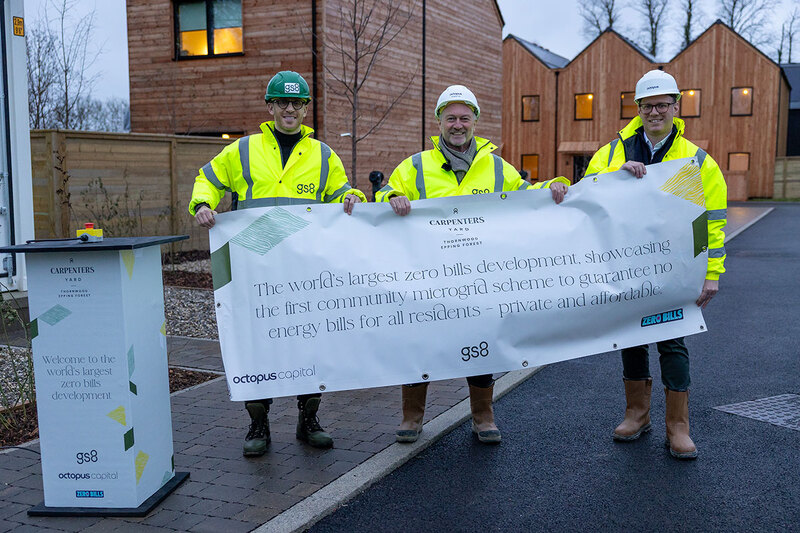
In October 2025, the Affordable Housing Fund bought 35 homes at Carpenters Yard in Epping Forest, Essex. The 113-home micro-grid community was funded by Octopus Capital’s debt team and delivered with sister company Octopus Energy. It is claimed to be the world’s largest zero-bill scheme. Each home has a heat pump, solar panels and access to a central battery system, with residents paying nothing for power.
Built by developer GS8, the scheme has been described by housing secretary Steve Reed as a potential blueprint.
“At the moment about 5% of our portfolio is zero-bill affordable homes. Some of the new money will prioritise building more and we expect that to rise to between 10% and 20% over the next couple of years,” Mr Burnham says.
The environmental benefit matches the social impact. Zero-bill homes are designed to be carbon-positive, meaning these produce more energy than consumed while also removing fuel poverty at source.
“In developing homes with zero bills, we’re doing something that maybe isn’t done in other parts of the world”
Investment decisions are guided by a bespoke internal ‘quality book’ which covers design, space standards, access to transport, healthcare and amenities.
Schemes with high service charges are typically ruled out and the focus is overwhelmingly on houses. Around 90% of the portfolio consists of family homes, with the remainder in low-rise schemes.
High-rise developments are largely avoided, reflecting a preference for simpler long-term management.
Octopus Capital does not manage homes directly, instead working with housing associations including CHP and Bromford Flagship.
Mr Burnham says partners undergo detailed due diligence of financial health, regulatory standing and resident engagement. This includes looking at customer satisfaction and how well the housing association handles complaints.
Geographically, the fund operates mainly in the South and East of England, with concentrations in the South East and South West. Expansion into the North of England and Scotland is under way, supported by a hub-based model.
Policy backdrop
While Mr Burnham is positive about the government’s commitment to housing, he would like to see a few changes, including reform of stamp duty land tax. Not-for-profit providers benefit from exemptions that are not always available to for-profit registered providers, even where homes are held in perpetuity at affordable rent, he says.
Above all, Mr Burnham wants greater economic stability. He says that lower interest rates would improve scheme viability and tenant affordability alike.
For a fund that is just three years old, growth has been solid. The real test will be whether institutional capital can evolve from niche investment into a cornerstone of affordable housing provision. Octopus Capital is clearly hoping it will.
The investor interview series
Man Group’s Shamez Alibhai on the shift to direct development
Man Group’s Community Housing Fund, which wants to double its portfolio and get involved in projects at an earlier stage. Managing director Shamez Alibhai sits down with Denise Chevin to explain why
How Octopus Capital’s Jack Burnham plans to reach 1,000 homes – then double it
After raising its first tranche of overseas investment, Octopus Capital is confident of scaling up and building more homes with zero energy bills. Denise Chevin speaks to head of affordable housing Jack Burnham to find out more
Thriving Investments’ Cath Webster sets out expansion plans
Thriving Investments, the investment manager owned by Places for People, is focusing on homes for essential workers as it scales its regional housing funds. Denise Chevin meets its chief executive, Cath Webster
Venn’s managing director Oriane Auzanneau on backing build-to-rent with government guarantees
Venn’s managing director Oriane Auzanneau tells Denise Chevin how government guarantees are reshaping housing finance and building investor confidence
Sign up to our weekly Living newsletter
Sign up to Inside Housing Living’s newsletter, bringing you exclusive analysis and big deals from the wider residential market, including build-to-rent, student living, later living, for-profit registered providers and more.
Click here to register and receive the Living newsletter straight to your inbox.
And subscribe to Inside Housing Living by clicking here.
Already have an account? Click here to manage your newsletters.
Related stories


