You are viewing 1 of your 1 free articles
L&G’s suburban dreams: why the asset manager is betting big on single-family homes
Britain’s largest asset manager Legal & General talks to James Riding about the rapid rise of single-family investment – and how it is trying to become a better landlord


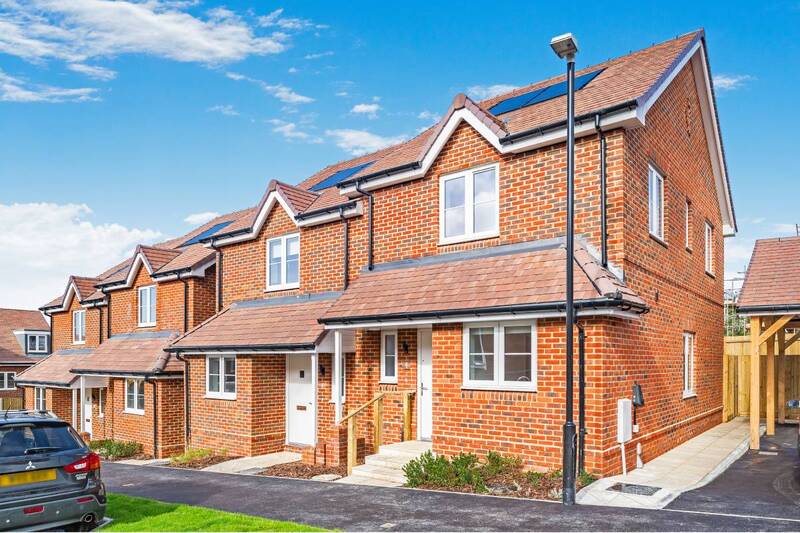 Giant asset manager Legal & General explains the rapid rise of single-family investment #UKhousing
Today Inside Housing launches its all-new Living Bulletin, focusing on exclusive analysis of the wider residential market. When we decided to expand to cover new subsectors of housing, it was easy to identify where we should focus first: low-rise, private rented houses, known in the industry as single-family homes.
The UK’s private rented sector, dominated for decades by buy-to-let landlords, is being shaped and professionalised by institutional investment. For the past 15 years, institutional investors have owned tall blocks of ‘build-to-rent’ flats in British cities. Now they cannot get enough of new build houses in the suburbs.
Last year, a record £2.5bn was invested in single-family houses in the UK, according to Savills – equal to the amount invested into multi-family build to rent. By contrast, between 2018 and 2022, the investment split was an average of just 5% single-family and 95% multi-family.
The rise of single-family comes at an interesting time for the private rented sector, as buy-to-let landlords quit the market due to tax changes and as the government’s Renters’ Rights Bill seeks to professionalise the landscape. Are institutional landlords here to stay in the suburbs, nestled alongside traditional housing associations? Or will house builders shift back to private sale as soon as the market changes? Inside Housing sat down with early mover Legal & General’s single-family director to find out more.
Surge in investment
At present there are around 14,000 operational single-family homes – ie build-to-rent houses owned by institutional landlords – and a further 13,000 under construction. When you add in high-rise, multi-family homes, the UK’s overall build-to-rent stock totals 127,000 homes. This is still a fraction of the wider private rented sector, which totals 4.6 million households, 60% of whom (2.8 million) live in houses.
Savills reckons the single-family market has room to grow to 32,400 homes a year, equating to around £10bn of annual investment.
Why the sudden surge in interest? The market landlords are targeting is no longer just urban professionals. Families are renting for longer as homeownership becomes less affordable. For investors, this is an opportunity for long-term returns that are closely correlated to inflation. They prefer tenants who are settling down and putting their children in school because they tend to be less transient, reducing turnover and homes sitting empty.
Most importantly, houses are much easier to build and less risky to manage in terms of building safety compared to high-rise blocks, with lower operating costs and fewer lifts and communal spaces to manage. Over the past year, a common refrain in build-to-rent circles has been exasperation over long delays dealing with the government’s Building Safety Regulator, which must approve all construction plans for tall buildings. Building low-rise housing until ministers iron out the kinks seems like a sensible alternative.
Big single-family investors over the past year include Lloyds Bank via its Lloyds Living arm, Sigma Capital, and Wall Street titans Blackstone and Goldman Sachs. But L&G launched its single-family platform all the way back in late 2020 and began investing in 2022.
“We like the demographic pool, we see the growth in the number of households,” says David Reid, managing director of suburban build to rent at L&G. His first batch of tenants include “a lot of couples, but certainly those with families”, too. “We’ve recently had our first young couple who were in one of our smaller houses ‘evolve’, if you like, into one of our larger houses, because they’ve had a kid.”
L&G decided five years ago that the fastest route to market was to forward-fund house builders and “we set about doing that mission”, he tells Inside Housing. The asset manager has committed £300m into the market over the past three-and-a-half years via deals with five different house builders and has a total pipeline of almost 800 homes.
Creating additionality
Last year, The i Paper criticised the rise of single-family investment, arguing first-time buyers were being “priced out of homeownership” because “mega-landlords” are buying up new build homes and raising rent. But Mr Reid is convinced that institutional investment in single-family homes is creating “additionality”, by helping to deliver more homes than would otherwise be built if house builders only sold to owner-occupiers and social landlords. He admits there is a “very large” market for buying up existing homes to retrofit (L&G’s for-profit registered provider is looking to do just that in the affordable housing space), but he says that is not his ambition for the single-family platform right now.
Rather, he argues that forward funding new builds can help smaller house builders grow. “The government’s ambition to deliver 1.5 million [new homes] is to some extent predicated on some of those SMEs becoming larger builders over time,” he says. “This market might help to stimulate that.” Signing a big development deal with an investor could give a small builder more confidence to compete for and acquire new sites, for example.
He also claims that the single-family market can be a “catalyst” for house builders to help them build large sites faster. “If you start with the single-family housing for private rent and the affordable housing, and your third tenure is private for sale, you already have two tenures locked up,” he says. “It has, with some of the builders, accelerated their delivery on sites, large masterplan sites especially.” He does not give any specific examples, but says he is currently working on a research paper with large publicly listed house builders to back up this assertion.
Mr Reid previously managed investments into L&G’s urban build-to-rent strategy from the former L&G Capital business. He is keen to stress that L&G still has an “enormous commitment” to high-rise renting and the move into single-family was a “diversification”, adding it shares learnings across the businesses.
“In my experience, where I’ve seen institutional investment go into a market, rarely does it come out,” he says. “The backdrop globally has been fairly volatile over this last three or four-year period… It’s interesting and quite remarkable in some ways, the amount of money that has gone in [to single family]. What does that say for its potential in an environment that we might now have?”
Staying the course
Yet an improving economic climate might bring its own challenges for the nascent single-family market. If interest rates and mortgage rates continue to fall, will house builders shift away from development deals with investors and move back to their original business model, selling to owner-occupiers?
“There will be some that will stay the course, partly because they’ve already set that course out to their shareholders as a three-year, five-year, 10-year plan,” Mr Reid says. “Their business models are predicated on that, and some of those are publicly listed.” He points out that Berkeley Homes, one of the UK’s largest house builders, has even set up its own build-to-rent arm to manage its homes in-house.
“There are others that we’re probably alluding to but not naming, that we know have traded into this market,” he continues. “I guess your question is, do they stay the course where the private sale market picks up again?”
He expects “at least a part of their revenue” to continue to come from selling to institutions. “It smooths out their cashflows across sites,” he says.
“What we need to do in the housing industry is smooth out the number of homes delivered. We go through economic cycles, and when it’s a boom time, we deliver more homes, and when it’s not, we deliver far fewer. The problem is that every time we deliver fewer, it accelerates and accumulates the number we haven’t delivered.”
Institutional investment into single family “helps to smooth out the number of homes that a house builder will and can deliver every year”, he adds.
L&G is in it for the long term, anyway. So, it is worth asking: would you want L&G to be your landlord? Mr Reid says he is focused on improving the health outcomes of his tenants, but “this isn’t about creating health tech apps”.
“Are we putting bike repair stations into every site? Are we putting defibrillators onto every site? The majority of our homes have heat pumps rather than gas boilers,” he adds.
It is a list that will sound familiar to most social housing professionals.
Sign up to our new Living newsletter

Sign up to Inside Housing’s new Living newsletter, bringing you exclusive analysis and big deals from the wider residential market, including build to rent, student living, later living, for-profit registered providers and more.
New to Inside Housing? Click here to register and receive our Living round-up straight to your inbox
Already have an account? Click here to manage your newsletters.
Related stories