You are viewing 1 of your 1 free articles
Investor interview: Aberdeen’s Robert McDonnell on why he is expecting more capital to flow into build-to-rent in 2026
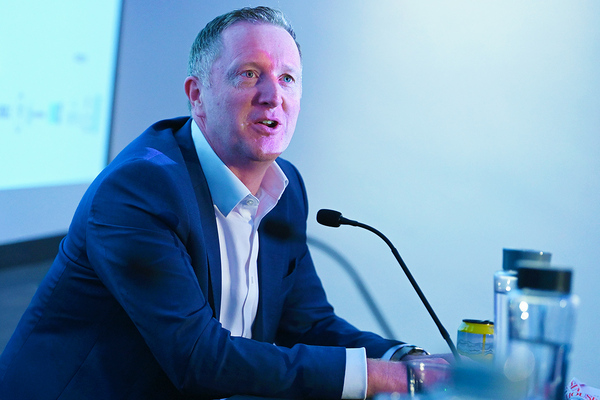
Robert McDonnell, a residential fund manager at Aberdeen, tells Denise Chevin that sentiment in housing investment is improving, with more capital expected to lift activity in 2026


 Investor interview: Aberdeen’s Robert McDonnell on why he is expecting more capital to flow into build-to-rent in 2026 #UKhousingRobert McDonnell, a residential fund manager at Aberdeen, tells Denise Chevin that sentiment in housing investment is improving, with more capital expected to lift activity in 2026 #UKhousing
Aberdeen
- Residential investment: £8bn or 30,000 homes across Europe and Asia (Aberdeen does not break down value of funds by geographic area), with 1,350 homes under management in the UK and Ireland
- Tenure: mostly multi-family for private rent
After several years marked by yield expansion (investors demanding higher returns due to higher perceived risk), higher construction costs and regulatory delays, Robert McDonnell, a residential fund manager at Aberdeen, believes the outlook is beginning to improve for residential investment – with 2026 shaping up as a year of renewed momentum.
“Our forecasts are positive and we anticipate increase in activity going forward,” he says.
The problem has been that interest rates have remained high and gilt yields (the return on government bonds) rose, which pushed up the return that institutional investors want to achieve from other investments. Residential assets have therefore had to be priced more conservatively, even though income fundamentals have remained strong, he says.
A better functioning Building Safety Regulator, which is now reducing delays to the Gateway 2 process, should also provide a better pipeline of schemes starting on site and more opportunity for investment.
Mr McDonnell says that after the Autumn Budget, there is now “a bit more certainty around the economic outlook… so we do expect more capital to flow into the sector and there is definitely an improving sentiment”.
Read more


For long-term institutional investors like the pension funds that make up Aberdeen’s core capital, housing continues to offer the combination of income stability and attractive risk profile that other property sectors have struggled to deliver in recent years. And while there may be short-term effects from policy changes, such as slightly higher vacancy levels, Mr McDonnell believes the fundamentals remain strong.
“The professionally managed build-to-rent sector is such a small percentage of the overall rental market compared to the US or Europe, and we can see that sector growing and growing,” he says.
Aberdeen’s track record of UK residential investment dates back to 1996.
Globally, the firm manages around £8bn of residential assets, representing approximately 30,000 homes across Europe and Asia, with continental Europe a significant part of that portfolio.
In the UK and Ireland, Aberdeen currently owns six multi-family build-to-rent schemes, totalling 1,200 apartments. Locations include Dublin, Leicester, Leeds, Stratford and Tooting in London, and Birmingham. It recently committed to forward-fund a 139-home single-family development in Cambridge.
“Residential suits pension fund investment – low risk and steady returns – because there is high demand and undersupply,” Mr McDonnell says. “First, we’ve not been building enough homes, but also people are now opting to rent as a lifestyle choice, adding to the demand.”
That combination has delivered what institutional capital is seeking: stable income and comparatively low volatility in capital values. As a result, Mr McDonnell is seeing a structural shift in allocation decisions.
“Traditionally, pension fund capital that is invested in commercial real estate – retail, office and industrial – is now looking to make an allocation to residential,” he says.
Investment strategy
Aberdeen’s residential investment strategy is underpinned by detailed research, beginning at a macro level before narrowing down to individual sites. It assesses population size, demographic trends, wage growth and affordability to identify locations with sustainable rental demand and returns.
Once an area passes that initial screening, the firm applies what it calls the “AAA” test – accessibility, amenity and affordability. “They’re the key drivers that we think tenants look at when they’re deciding to rent,” Mr McDonnell explains.
Aberdeen prioritises accessibility to employment centres and transport, alongside local amenities, rather than relying solely on in-building facilities. From there, the company works with development partners to buy assets, either through forward-funding or purchasing existing homes.
“Residential suits pension fund investment – low risk and steady returns – because there is high demand and undersupply”
“The benefit of the forward-funding route is you have that early access to assets,” Mr McDonnell says. “You’ve got an opportunity to influence design, which is important especially with all the Building Safety Act requirements, and making sure the operational expenditure costs are appropriate and that the scheme is income-resilient.”
Existing homes, on the other hand, provide immediate income and speed to market. Where appropriate, Aberdeen looks to enhance performance through refurbishment. At a scheme in Leicester, internal upgrades enabled rents to move “way ahead of where our business plans were, yet were still appropriate for the demographic”, he explains.
Viability and pipeline constraints
Despite improving sentiment, Mr McDonnell is clear that challenges remain, particularly around development viability and the availability of investable stock.
“Viability is an issue, as is a pipeline of developments, which has been impacted by the delays of taking schemes through the Building Safety Regulator,” he says.
Over the past three years, rental growth helped to offset outward yield movement (falls in the asset values that increase pressure to improve yields), but construction cost inflation continues to squeeze development economics.
“We’re not taking development risk or delivery risk but for a developer, the deal needs to stack up. They still need to take their 10% to 15% profit on cost,” Mr McDonnell says.
Land pricing is a recurring problem. “Sometimes land values don’t reflect the appropriate value to make development stack up,” he says. “The opportunities to forward-fund schemes or buy schemes are just not there at the moment.”

Safety, regulation and certainty
New building safety regulations have become central to investment decisions, particularly when assessing standing assets. Mr McDonnell highlights means of escape as a key factor.
“Our preference is to have dual means of escape for high-rise buildings,” he says. “A lot of first and second-generation build-to-rent schemes only had one means of escape, so they wouldn’t comply with today’s building regulations.”
As a result, Aberdeen may favour lower-rise or newly built stock, where regulatory compliance is clearer and long-term investment risk is reduced.
Certainty matters not just at asset level but for capital planning. “From a capital allocator perspective, we’re keen to have certainty,” Mr McDonnell says. “We want to know we can start on site in a specific quarter or month.”
Delays and uncertainty, by contrast, create knock-on effects. “It isn’t helpful,” he says, pointing to planning as a persistent issue.
While acknowledging the government’s efforts, he adds: “It’s really about resource at the local level to improve speed of responses and processes.”
“The benefit of the forward-funding route is you have that early access to assets. You’ve got an opportunity to influence design”
He points to Scotland as an example of how policy changes can influence institutional appetite.
“Clarification around rental caps has been a huge positive,” he says, talking about the Scottish government’s decision to lift the blunt temporary rent control measures and introduce a more measured approach through the new Housing (Scotland) Act.
“It shows how capital is now starting to look at Scotland again, where before it was a lot more hesitant,” he adds.
Sector preferences and ESG
While some residential investors interviewed for this series have said they are looking to concentrate on lower-rise schemes, Mr McDonnell says of Aberdeen: “We’re really positive around both single-family housing and multi-family.”
He stresses that investment decisions are deal-led rather than driven by a strategic preference.
However, purpose-built student accommodation, where Aberdeen has £620m investment in the UK, is viewed more cautiously.
“There is nuance,” he says. “Some of the vacancy rates are starting to creep up”, which is potentially linked to fewer international students – though he acknowledges strong performance in specific university locations.
Social rent is not currently part of Aberdeen’s strategy, but the company is exploring how best it might gain exposure to this sector in the future. Within multi-family schemes, however, the firm does deliver discounted market rent. “The key for us is that we are able to manage the asset as one,” Mr McDonnell explains.
Like other investors, environmental, social and governance (ESG) considerations are embedded across the investment process.
“The great thing about residential is that you can have a real positive influence,” Mr McDonnell says, pointing to urban regeneration, energy-efficient buildings and lower resident bills. “You can have a positive, tangible impact on the local neighbourhood.”
Looking ahead to 2026, Mr McDonnell’s outlook is one of measured confidence. Interest rate reductions, improving certainty and strong fundamentals are aligning, even as challenges around viability and supply persist. For institutional investors, residential remains a compelling long-term play – one that Aberdeen is positioning itself to grow.
The investor interview series
Man Group’s Shamez Alibhai on the shift to direct development
Man Group’s Community Housing Fund, which wants to double its portfolio and get involved in projects at an earlier stage. Managing director Shamez Alibhai sits down with Denise Chevin to explain why
How Octopus Capital’s Jack Burnham plans to reach 1,000 homes – then double it
After raising its first tranche of overseas investment, Octopus Capital is confident of scaling up and building more homes with zero energy bills. Denise Chevin speaks to head of affordable housing Jack Burnham to find out more
Thriving Investments’ Cath Webster sets out expansion plans
Thriving Investments, the investment manager owned by Places for People, is focusing on homes for essential workers as it scales its regional housing funds. Denise Chevin meets its chief executive, Cath Webster
Venn’s managing director Oriane Auzanneau on backing build-to-rent with government guarantees
Venn’s managing director Oriane Auzanneau tells Denise Chevin how government guarantees are reshaping housing finance and building investor confidence
Sign up to our weekly Living newsletter
Sign up to Inside Housing Living’s newsletter, bringing you exclusive analysis and big deals from the wider residential market, including build-to-rent, student living, later living, for-profit registered providers and more.
Click here to register and receive the Living newsletter straight to your inbox.
And subscribe to Inside Housing Living by clicking here.
Already have an account? Click here to manage your newsletters.
Related stories